
The Candle of Hope and the “Four Last Things”
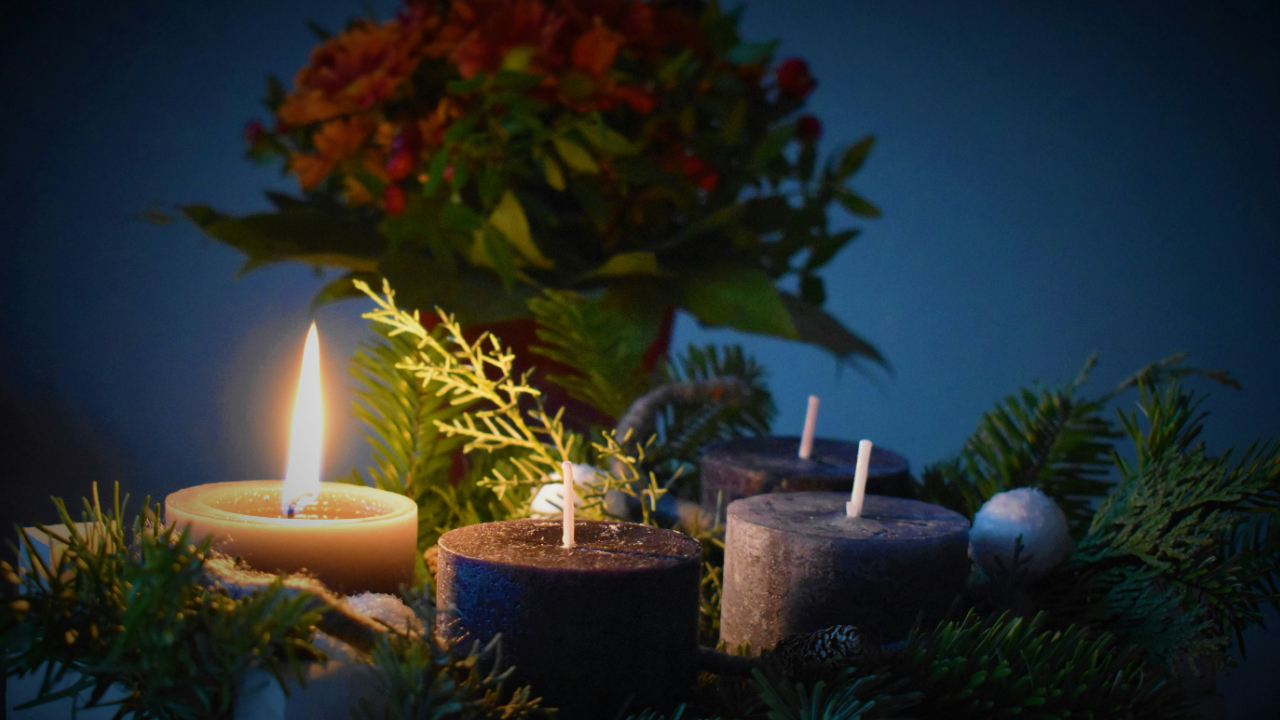
We are once again entering the exciting season of Advent. During the weeks leading up to Christmas, the church traditionally observes four familiar themes—hope, peace, joy, and love. These themes warm our hearts and stretch the Christmas season from a single day on December 25th into several weeks of anticipation. And you have to admit, the religious season of Advent lines up neatly with our cultural norms. For many of us, the Christmas season really begins the moment the turkey leftovers go into the fridge. The beautiful Advent topics become four gentle steps that lead us toward the manger.
The Original Four Topics Were Much Darker
Although it is well known, the average Protestant churchgoer is unaware that hope, peace, joy, and love were not the original themes of Advent. During the medieval period, the four weeks before Christmas focused on meditations that were much heavier—and certainly darker. The church traditionally referred to them as “the four last things.” Author Fleming Rutledge, in her book Advent: The Once and Future Coming of Jesus Christ, explains that the Advent meditations were centered on death, judgment, heaven, and hell—specifically in that order.
That’s right, the early church preached on hell on the Sunday before Christmas Eve!
Rutledge notes that the point was not to frighten people, but to show “how the light of the birth of Christ appeared against the backdrop of darkness, depravity, and despair.”
Please don’t think I am about to argue that we should abandon the themes of hope, peace, joy, and love in the name of returning to tradition. I humbly note that there is no biblical mandate to observe the season of Advent at all, much less to assign themes to it. But it did strike me, as I began to consider the first topic of the season, that the four last things practically cry out for hope.
The Candle of Hope and Death
Hope is essential when we think about death. Death has a way of humbling us, forcing us to face things we cannot control. It pushes us to ask big questions and helps us put our priorities in the proper order. When faced with approaching death, people naturally begin thinking about what really matters. And by the way, the number of likes on your most recent social media post, the number of followers on your channel, and the number of digits in your bank account are not going to be on that list.
The Bible never asks us to pretend that death is small. But it does instruct us to anchor ourselves in something huge. Paul wrote, “If in Christ we have hope in this life only, we are of all people most to be pitied” (1 Corinthians 15:19, ESV). In other words, if death has the final word, then hope is snuffed out.
But for the believer, hope is not darkened. Paul goes on to speak of Jesus' resurrection. He calls Christ the “firstfruits” of those who have died. In that agricultural society, the firstfruits were the first portion of the harvest offered to God. The idea was simple: if the firstfruits were given, then the full harvest was sure to follow. If Jesus is called the firstfruits, then a future resurrection for us will follow—that’s the entire harvest.
When the church meditated on death during Advent, that was the point. It was not morbid. It was not fear. It was the reassurance that hope was bright enough to shine a light into the darkness of the grave and dispel all of its shadows. Like a flickering candle, the birth of Christ forecasts the conquering of death. Jesus came into this world swaddled in cloth, and He seemed to leave this world swaddled in cloth. But three days after His death, the flickering flame of hope exploded into the brilliant light of assurance. Death ain’t that dark after all.
The Candle of Hope and Judgment
Hope is essential when we think about judgment. It is a sobering thought to recognize that every word, every action, and every motive will be laid bare before the God of Heaven who sees and knows all. Let me underscore what I just said. On the day of judgment, it is not only outward actions that will be declared, but inward motives that will be revealed.
Let me be honest enough to say that there are moments in my past I would rather forget. And when judgment looms, I need hope. That hope is found in Christ. That hope is strong enough to enable me to face judgment without fear. “There is therefore now no condemnation for those who are in Christ Jesus” (Romans 8:1, ESV). These words are not poetic exaggeration. They are evidence of a legal verdict. The Christian does not fear judgment because the righteous Judge has already rendered His decision.
What was the decision of the Judge? I can assure you it was not a declaration of “innocent.” Instead, it was the declaration that Christ has borne the punishment for sin. When the church meditated on judgment during Advent, it did not crush their souls. It highlighted that the believer’s only confidence is in the cross of Christ. The gavel has already banged, and the sentence landed on Him. That is the only reason we have hope.
The Candle of Hope and Heaven
Hope is essential when we think about heaven. Heaven is that place where every longing finally finds its home—where every promise God has ever made finds its fulfillment. The world often accuses religion of creating the idea of heaven merely to comfort the grieving. But when the New Testament speaks about heaven, it describes it as a matter of fact; it is “an inheritance that is imperishable, undefiled, and unfading” (1 Peter 1:3–4, ESV). The words are important here. Our inheritance is not fragile. It is not at risk. It is certainly not a pipe dream. Heaven is a real place, guarded by God Himself. It is called an inheritance—guaranteed by the last will and testament of Jesus Christ, and secured by His resurrection.
The hope of heaven is not just the pleasant idea of a pretty place. Jesus is the only One who makes heaven our hope. If you were to remove Christ from heaven and keep all the other details we know about that place—the street of gold, the beautiful city, the fruit trees, the crystal river, the white robes, and the jeweled crowns—heaven would yet be empty of hope without Christ.
When the church meditated on heaven during Advent, it was meant to stir their anticipation. And not merely the anticipation of escaping this world, but the anticipation of encountering Christ face-to-face. His presence alone will be the reason every heart is healed, every relationship restored, and every tear wiped away. An old song once said, “Jesus will be what makes it heaven to me.”
The Candle of Hope and Hell
Finally, hope is essential when we think about hell. Hell is an uncomfortable topic, yet Scripture will not allow us to ignore it. It has often been observed that Jesus spoke more about hell than anyone else in the New Testament. Hell is that sobering reminder that sin is devastating, and that separation from God is the greatest tragedy a human soul could ever endure.
Here—especially here—we desperately need hope. And this is where hope speaks its loudest word. “The Lord… is patient toward you, not wishing that any should perish, but that all should reach repentance” (2 Peter 3:9, ESV). For the believer, the thought of hell does not lead to despair. It leads to overwhelming gratitude. The idea of what Christ has saved us from leads our hearts into worship. Hell magnifies hope—it becomes even larger when we see it against the backdrop of what we truly deserve.
When the medieval church meditated on hell during Advent, it was intended to strike awe in the heart of every believer at the wonder of salvation. In light of the flame of hope, the subject of hell does not produce dread, but it becomes a testimony to the depth of Christ’s mercy, the terribleness of my sin, and the inexplicable love of Christ for the sinner. Even against the shadow of hell, the candle of hope burns bright.
Let the flame of hope be lit once more. Neither death, nor judgment, nor heaven, nor hell can diminish the message of that candle. In the shadow of the four last things, hope burns brighter than ever.
Be encouraged. The Christ child comes.
